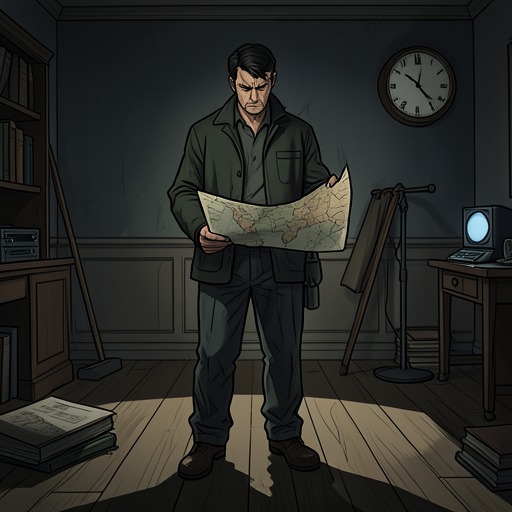
Indecision Is All Loss
The Last JediIndecision Is All Loss is a rule of action that binds urgency to the danger of isolation. For Jax Pavan, hesitation is not merely a delay in choosing: it can become loss, even death. Yet a message from Aoloiloa and a network of Cephalons complicates that hard lesson. Jax hears that he must act to recover Tuden Sal, but also begins to suspect that acting alone may be the very separation that threatens everyone.
Meaning and Stakes
The rule’s force comes from the consequences Jax attaches to indecision. As he considers going forward without Den Dhur and I-Five, he recalls that hesitation results in loss and death. The principle is therefore practical as well as philosophical: choices made under pressure affect whether people survive, and postponement can carry its own fatal cost. Jax does not treat the risk as abstract. If he goes alone and fails, the others remain able to carry on; if they accompany him and he fails, he cannot bear to complete the thought.
That calculation does not settle the choice. Jax has several reasons to leave his friends behind, including their safety and the resistance’s need not to lose more capable people. But he also recognizes a third reason: their palpable distrust distracts him. In his thinking, distrust can foster indecision, and indecision can lead to death. The rule thus operates within a strained relationship, not outside it. Going alone may reduce one source of hesitation, while increasing the danger to Jax himself and placing the burden of continuing on those left behind.
A Choice Made Under Distrust
Jax’s decision to part from Den and I-Five is an attempt to manage competing risks. He tells himself that he is not unhappy they will stay behind, because their safety and the resistance’s survival matter. But his reasoning also exposes how difficult it is to distinguish resolve from isolation. Their distrust has become a distraction; separating from them seems a way to silence that distraction and move forward. The rule encourages decisive action, yet the scene shows that decisiveness alone cannot guarantee a sound choice.
The thought of death interrupts Jax’s reasoning. He turns over the Jedi maxim that there is no death, then considers the possibility that death exists for those left living, even if it does not exist from the dead person’s point of view. This reflection does not erase the practical stakes. Instead, it brings the cost of a failed choice into sharper focus: the people who remain may have to live with the loss. The principle’s severity is measured not only by the person who might die, but by the companions who would have to continue without them.
The Cephalon Warning
Later, in the cockpit of the Aethersprite amid a Mid Rim asteroid field, Jax senses presences that displace his awareness of the recognizable consciousness of the Whiplash leader. The communication feels at once familiar and unfamiliar. He recognizes Aoloiloa, but understands that the message is coming not from that Cephalon alone: it is carried by a living network of Cephalons linked together. Their intervention gives the rule a new urgency and a wider scope.
The first warning joins indecision to Yimmon’s separation, declaring, “Listen. Indecision is all loss. Yimmon’s separation destroys us all.” Jax objects inwardly that he has heard this already and wonders what more he can do with it. The network repeats the warning, but not in exactly the same form: “Separation destroys us all”; then “Separation destroys us”; then “Separation destroys.” Jax notices the changes and grows frustrated that the Cephalons will not speak more clearly. The repetition does not simply restate a fixed instruction; its gradual contraction leaves him to work out what kind of separation matters.
From Urgency to Interdependence
Jax takes one implication immediately: he has to get Tuden Sal back and has no more time to delay. The warning has moved him from contemplation to action. But he then asks whether it means he should not do this alone, or whether it is his own separation that destroys. Those questions expose a tension already present in his decision to leave Den Dhur and I-Five behind. The rule does not tell him simply to choose faster; the Cephalons’ changing message suggests that acting decisively while severing himself from others may still be disastrous.
The answer comes not as a plain explanation but as a powerful sense that Jax is not alone in the cockpit. The scene stops short of resolving the practical choice or showing the result of his effort to recover Tuden Sal. Instead, it changes the meaning of the rule at the moment Jax is prepared to act: loss can follow from indecision, but separation may also be a source of loss. The warning therefore makes decisive action inseparable from recognizing connection. Its force lies in that double demand—do not delay, and do not mistake solitude for resolve.